
ChatGPT has officially entered the world of advertising.
OpenAI launched an advertising pilot in the U.S. on February 9, 2026 and has since expanded its ChatGPT Ads business to other countries, attracting thousands of advertisers to the platform and even rolling out ChatGPT Ads through its Ads Manager.
ChatGPT Ads is no longer a mere experiment for marketers. As of September 2026, OpenAI claims that the project has been able to attract tens of thousands of advertisers.
In less than 200 days after launch, OpenAI said ChatGPT Ads had reached a $1 billion annualized revenue run rate.
This presents new opportunities for companies, but also raises important queries.
Table of Contents
Here’s what marketers and advertisers need to know about ChatGPT advertising in 2026
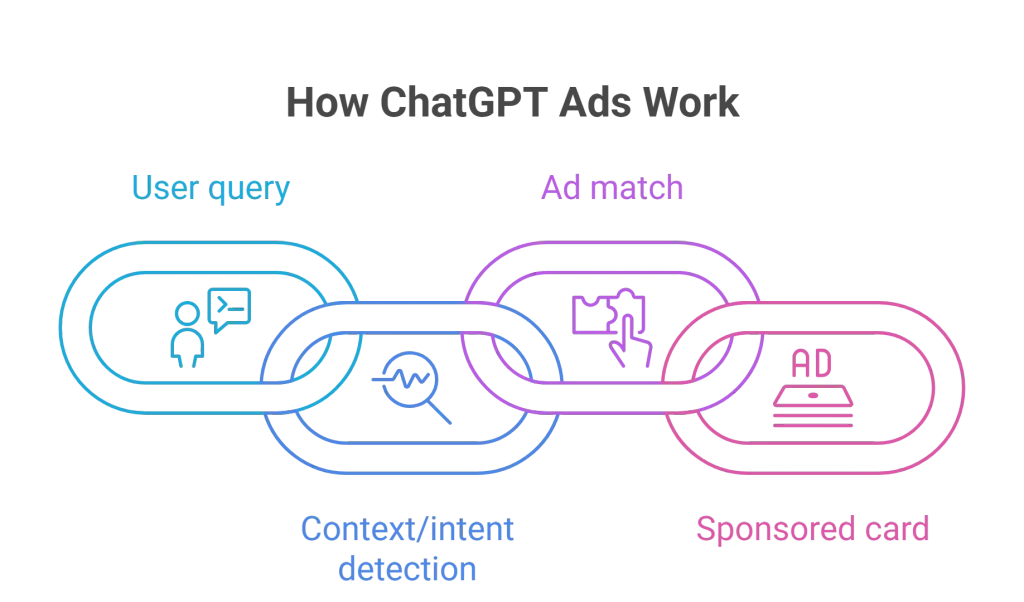
How ChatGPT Ads Work
This is the fundamental process:
Advertiser creates campaign → selects objective and targeting → creates ad groups and creatives → OpenAI reviews the campaign → eligible ads are matched to relevant conversations → advertiser monitors performance
Objectives of ChatGPT Ads
There are three objectives of ChatGPT Ads:
- Reach
- Clicks
- Conversions
Who Sees ChatGPT Ads?
ChatGPT Ads are currently associated with Free and Go versions.
OpenAI’s recent documentation states that:
- Free version users may see the advertisements.
- Go users may see the advertisements.
- Plus users do not have to see the advertisements.
- Pro users do not see the advertisements.
- Business users do not see the advertisements.
- Enterprise users do not see the advertisements.
- Education users do not see the advertisements.
- Accounts owned by people under the age of 18 do not see the advertisements.
What Is ChatGPT Ads Manager?
This is an important distinction because a ChatGPT Plus user may never get exposed to the advertising experience of a free user.
The ChatGPT Ads Manager is OpenAI’s platform for launching and running ChatGPT Ads campaigns.
According to OpenAI, Ads Manager is the platform that allows advertisers to manage their campaigns, track results and update them.
Ads Manager is beneficial to advertisers in many ways:
- Create a campaign
- Set objectives and Budgets
- Create ad groups and ads
- Select target customers
- Configure targeting
- Monitor impressions, clicks and conversions
- Download performance reports
- Manage billing and account permissions
This product is still in Beta version, and it is expected to change as every new update including improvements is incorporated.
ChatGPT Ads Formats
The main ChatGPT advertising formats include:
| Format | Current status |
| Standard ChatGPT ad | Current |
| Product-feed-based advertising | Emerging/current capability; availability may vary |
| Additional formats | Planned/being developed |
How ChatGPT Ads Appear
A typical ad would look as follows:
Advertiser/Brand → Logo → Headline and Text of the Ad → Picture → Landing Page
The ad would be clearly marked as “Sponsored” and would be visually differentiated from ChatGPT’s answers.
For instance, if someone were to inquire, “What are the best running shoes for newcomers?” it would be possible for a sports retailer to exhibit a sponsored advertisement. Ads may appear below a ChatGPT response when there is a relevant match.
How to Advertise on ChatGPT
If you are wondering how to advertise on ChatGPT, let us take you through Eight Steps of the process.
Step 1: Create Your ChatGPT Ads Manager Account
To access the OpenAI Ads Manager, first sign in with your OpenAI account that is linked with your business.
OpenAI Ads Manager
While creating your account, you will be required to provide the following details:
- Name of the business
- Website for the business
- Country or region where the business is located
- Currency used
- Time zone
- Logo of the brand
Step 2: Set Up Billing and Payment
Make sure you have set up your billing profile properly and have added an accepted payment method prior to starting your campaigns.
Your billing setup may include:
- Details about your business
- Your billing address
- Email for invoicing
- Information about payment method
- Tax information if you need it
If these billing and verification steps aren’t completed, campaigns cannot begin serving.
Step 3: Create Your Campaign
Open Ads Manager and start a new campaign from the campaign creation workflow.
A campaign defines the aim and budget of your advertising activity.
You can select:
- Name of the campaign
- Objective of the campaign
- Budget
- Starting and finishing dates
- Countries targeted by the ad
- Platforms chosen for your ad
- If applicable, the conversion event
As of now, OpenAI offers CPM and CPC objectives, along with oCPC for conversion-focused campaigns.
| Pricing Model | How It works | Best For | Formula | Notes |
| CPM (Cost Per Mille) | Per 1,000 Impressions | Brand Recognition, Marketing Initiatives | Cost of campaign=(no of impressions/1,000)x CPM | Payment is required despite clicks; useful when visibility is key |
| CPC (Cost Per Click) | Per Valid Click | Web Traffic Interactions | Cost of campaign=Clicks x CPC | Advertisers pay per valid click. |
| oCPC (Optimized/Conversion Focused CPC) | Per Clicks, but delivery optimized towards conversions | Sales/acquisitions, Lead Generation | Conversion-optimized cost per click. | Excellent for performance marketers; but conversion tracking (using either API or pixels) must be properly established. |
One such strategy could be starting off with CPM for awareness, trying CPC for traffic, and then using oCPC when conversion tracking is available. This is just a strategy suggestion and not a requirement from OpenAI.
Step 4: Choose Your Budget and Targeting
Your campaign’s budget decides how much you can spend during the campaign.
Ads Manager offers the option of setting average over seven days budgets. OpenAI’s latest documentation states the different minimum daily budgets for various billing currencies. For example, OpenAI currently lists a $25 USD minimum daily budget for U.S. ad accounts. Minimums vary by billing currency and country.
You can also choose the location where your ads can run.
Campaigns support country-level targeting. In the United States, advertisers can also target supported states, DMAs and ZIP codes. Location options vary by country.
Moreover, you can also target platforms such as iOS, Android, and web where ChatGPT can be used effectively.
Step 5: Create Your Ad Group
ChatGPT use a three-level structure:
Campaigns ⇒ Ad Groups ⇒ Ads.
Campaign = objective, budget, dates, countries/platforms
Ad group = grouping + contextual hints
Ad = creative
Advertising campaigns use this structure for introducing ads based on specific themes or intents that are important for advertising in the immediate context.
One of the advantages of using ad groups is that you can provide clues about the contexts of conversation to help your audience identify what you mean.
For example, if you are a fitness company, you would execute the following advertising campaign:
Campaign: New Customer Acquisition
Ad Group 1: Home workouts
Context clues: home gyms, training at home, exercise equipment.
Ad Group 2: Running
Context clues: running shoes, marathon training
It should be clear that this approach allows you to reach out to people through different ads rather than relying on a single ad for every context.
Step 6: Create Your ChatGPT Ad
The individual advertisement is the crucial asset that can potentially be shown to the users.
OpenAI’s current guidance includes the following creative requirements:
- Advertiser/brand name
- Favicon or logo
- Title
- Ad copy
- Landing page
- Image creative
OpenAI has some recommendations regarding ad’s title, copy, image, and landing page:
- Ad title: between 16-24 characters, maximum – 50 characters
- Ad copy: between 32-48 characters, maximum – 100 characters
- Image: square PNG or JPG, maximum – 1200 by 1200 pixels
- Landing page: valid, reachable, and not blocked by OpenAI crawlers.
For example:
Brand: Aamna Fitness
Title: Build Strength at Home
Copy: Premium gear for better workouts.
Image: Product/lifestyle image
Landing page: Aamna Fitness home-gym collection
According to OpenAI, it is better to generate several unique combinations of title and copy instead of using the same phrase again and again. One of the purposes of this approach is to provide the service with different perspectives, which can be suitable in various situations of conversation.
Step 7: Submit Your Campaign for Review
The advertisement must go through its review process before it can go live.
Check that:
- Your account is verified
- Billing is completed
- Campaign dates are accurate
- Your campaign and ad groups are correctly set-up
- Your landing page is functioning
- Your creative is eligible
- Your advertisements are compliant with OpenAI’s policies
When approved, your campaign will be live.
Step 8: Launch and Monitor Performance
Once your ads are live, use Ads Manager to check the campaign performance.
Current reporting may contain the following metrics:
- Impressions
- Clicks
- Expenditure
- CTR
- Average cost-per-click
- Average cost-per-thousand impressions
- Conversions, where conversion tracking is set up
Ads Manager provides different reporting formats like table formats, performance visuals, and downloadable CSV reports.
Real-time reporting is not always mandatory. According to OpenAI, it takes just a few minutes for impressions, clicks, and CTR to show up, but spending information may take more time.
What If You Cannot Access ChatGPT Ads Manager?
Access issues can happen due to the use of an incorrect OpenAI account or if the user doesn’t have access to the relevant Ads account.
To solve this issue, OpenAI advises the users to check whether they are logged in to the OpenAI account associated with the organization and whether they have access to the appropriate Ads Manager account.
In addition, if the organization already has an OpenAI tenant, an administrator should grant access to the right Ads Admin role through the OpenAI admin console.
How ChatGPT Ads Target Users
A major difference between ChatGPT advertising and traditional keyword advertising is the context.
Google Search Ads are mainly based on search queries and keywords, while ChatGPT Ads can make use of signals from the current conversation such as conversational intent and context; if ad personalization is turned on, OpenAI may also employ some of the signals from the user’s wider ChatGPT experience.
For example, imagine someone asks:
“I am going to be living in a small apartment and therefore need a small desk for working from home”.
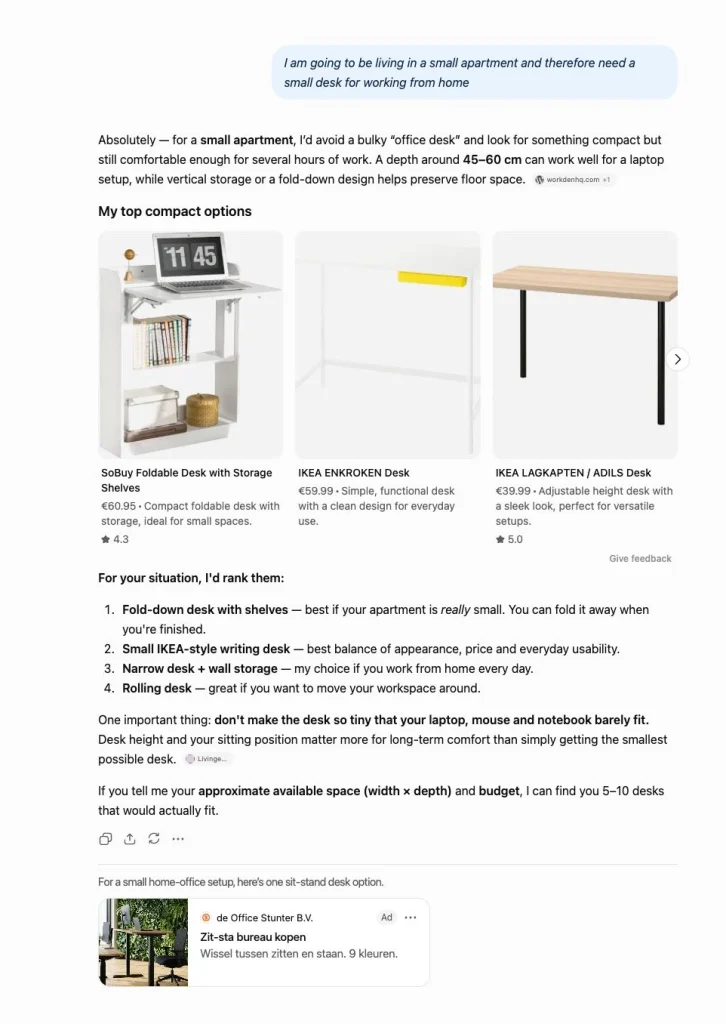
Instead of targeting only the keyword “desk,” a ChatGPT advertising system can consider the broader context:
Small apartment + work from home + compact furniture + desk
It is therefore essential for ChatGPT advertising to focus on conversational relevance.
Are ChatGPT Ads Safe and Private?
Because of the surrounding discussions on privacy, advertising through AI assistance becomes a major issue.
OpenAI states that advertisers do not receive user’s private chats, chat history, memories, names, email addresses, precise locations, IP addresses, or sensitive information.
The ad system will however be able to make use of different signals with regards to selection of ads including the context of conversation or other signals used in case a person enables personalization.
This distinction is important:
This makes it clear that while ads may be relevant to you, your conversation would not be shared with ad providers.
Frequently Asked Questions
Does ChatGPT have ads?
Yes, OpenAI launched the testing of ChatGPT Ads as of February 2026 and has since expanded to additional markets. Ads can be displayed for eligible Go as well as Free users.
Why does ChatGPT have ads?
OpenAI states that the advertising is aimed to provide a broader access to ChatGPT as well as facilitate the development of this service, which enables its availability.
How much do ChatGPT Ads cost?
Currently, ChatGPT Ads can be purchased based on CPM and CPC formats and conversion-optimized campaigns are possible as well. The price will depend on the aim of the campaign, the method of bidding, among others, but not on a specific ad cost.
Is AI advertising illegal?
AI advertising is not inherently illegal. However, an advertisement must comply with applicable law, and it must also satisfy OpenAI’s separate advertising policies. A legally permissible advertisement may still be rejected by OpenAI.
Can advertisers see my ChatGPT conversations?
OpenAI states that advertisers do not receive users’ private conversations or other protected account information.
Do ChatGPT Ads influence ChatGPT’s answers?
According to OpenAI, advertisements are separate from ChatGPT’s answers and advertising does not influence the answers ChatGPT provides.
Where can I access ChatGPT Ads Manager?
Advertisers can access OpenAI’s Ads Manager at its official website ads.openai.com, provided they meet the eligibility criteria based on the country they are from and the type of business they own.