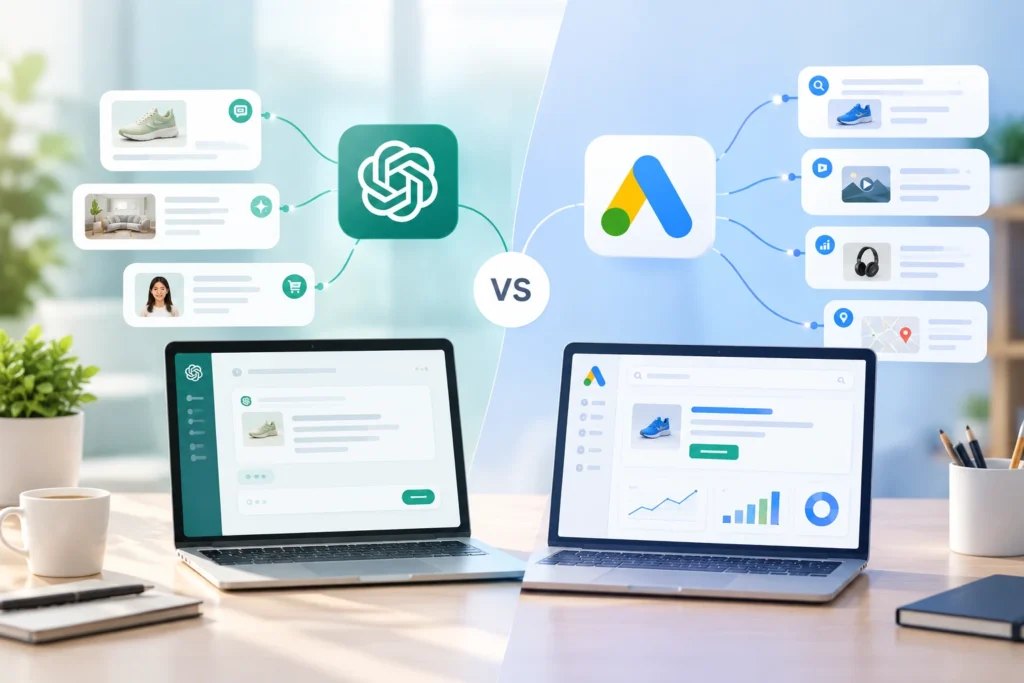
Google Ads has been one of the most established online ad platforms on the internet for years. But now, there is a new service known as ChatGPT Ads that offers a different way for companies to interact with their potential customers through AI chats.
However, ChatGPT Ads and Google Ads are not the same services. Google Ads revolves around the search habits of users while ChatGPT Ads take into consideration the context of the conversation being held. Also, Google is introducing more AI features to its advertising platforms, which shows that this is not merely a matter of traditional search against AI.
Here are the key differences to keep in mind before deciding where to invest your money.
Table of Contents
ChatGPT Ads vs Google Ads at a Glance
| Features | ChatGPT Ads | Google Ads |
| Core environment | Conversational AI | Search and broader Google ad ecosystem |
| Ad matching | Conversational context, intent and other relevance signals | Search queries, keywords and AI-powered matching depending on campaign type |
| Ad placement | Below ChatGPT responses | Search results and other Google properties/inventory depending on campaign |
| Context hints | Yes | No equivalent feature with the same role |
| Objectives | Views, clicks, conversions | Objectives and campaign types vary |
| Pricing | CPM, CPC and conversional-optimized buying options | Varies by campaign type and bidding strategy |
| Measurement | Impressions, clicks, spend, CTR, CPC, CPM and conversions | Extensive campaign, search-term and conversion reporting |
| Platform maturity | Ads Manager beta | Established ad platform |
According to OpenAI, ChatGPT Ads are shown below the answers and are selected based on the signals such as the conversation context and intent, destination URL, titles and texts of the ads, and context hints provided by the advertiser. Google provides different kinds of campaigns and targets depending on the purpose of the ad campaign.
1. Search Queries vs. Conversations
This is the biggest difference.
A Google search user might type:
“Best CRM for small business”
A ChatGPT user might ask:
“I run a small sales team and need a CRM to organize leads and follow-ups. What should I look for?”
The first would be a basic search query, while the second provides a more detailed story from the user’s side.
ChatGPT Ads can understand the context of the current conversation and intentions of the user in evaluating the relevance of the ad. On the other hand, Google Ads relies on search queries, keywords, and increasingly AI-powered matching to connect advertisers with relevant searches.
The difference in practice is that ChatGPT gives the advertisers access to users at different stages of their decision-making process.
2. Keywords vs. Context Hints
Google Ads has traditionally given advertisers keyword-based controls for search campaigns, alongside other targeting and automation features.
ChatGPT Ads takes a different route altogether.
Advertisers can use Context Hints at the ad group level to define the kind of product or service they offer, who it would benefit, and in what kind of situations it would be useful. OpenAI makes it explicit that Context Hints are not the same as exact-match keywords, nor do they ensure the appearance of an advertisement in a particular conversation.
One example would be a CRM marketer using a Context Hint such as:
“CRM software for small businesses that need to organize customer leads, sales pipelines and follow-ups.”
The goal is not just to repeat keywords, but to provide useful context instead.
For a detailed explanation, see Fleviko’s full guide to ChatGPT Ads Context Hints.
3. Where the Ads Appear
ChatGPT Ads are built to provide a conversational user experience. OpenAI mentions that ads will appear below ChatGPT responses and can include the brand name, headline, body, landing page, and visuals of the advertiser.
In comparison, Google Ads represents a much larger advertising ecosystem. Depending on the kind of campaign, ads can be placed on Search and other Google platforms.
Thus, advertisers do not have a choice between two versions of the same placement. Instead, they choose between different environments where users find and evaluate businesses.
4. Campaign Objectives Are Different
At present, ChatGPT Ads Manager provides three primary campaign objectives:
- Views – optimization based on exposure and charged according to CPM.
- Clicks – optimization based on traffic to a website or product and billed only for valid clicks
- Conversions – optimization based on conversion events, using conversion-optimized bidding (oCPC or oCPM).
Google Ads has a wider variety of campaign objectives and types of campaigns, including campaigns with such goals as sales, leads, and traffic.
Consequently, Google and ChatGPT Ads campaigns are not interchangeable.
While the two campaign types may be promoting the same product, they use different approaches, signals, and optimization systems.
5. Targeting Works Differently
Google’s targeting strategies vary depending on the campaign and include keyword targeting, geography targeting, audience targeting and content-based targeting. An additional tool offered by Google is the Search Terms Report, which shows the actual search queries that triggered your ads, along with how much traffic and relevance each one generated.
ChatGPT Ads use a different combination of signals.
According to OpenAI, there are factors which influence code-centric ad selection:
- Current context and intent of conversation
- Landing page
- Ad’s title and copy
- Context Hints
- Selected signals from a user’s broader ChatGPT experience when ads personalization is enabled
This makes relevance within the conversation an important part of ChatGPT advertising.
6. Cost and Bidding Are Not Directly Comparable
The question that arises when comparing different advertising options is:
“What’s a cheaper option?”
The problem, however, is that there isn’t a definite answer to this question.
The cost of advertising on Google will depend not only on the campaign and the sector of the business, but also on a number of other factors such as bidding strategy and the overall competition in the industry.
ChatGPT also features advertisements that can be bought using either CPM bidding or CPC bidding. For conversion campaigns, advertisers can choose either oCPC or oCPM bidding.
According to the Ads Manager guide released by OpenAI, the minimum daily budget required for creating an effective advertising campaign in ChatGPT should be $25. However, this figure does not mean that ChatGPT will bring the same return as Google advertising.
The analysis of the difference between CPC, CPM and budget doesn’t determine which bidding approach is better for a specific type of campaign.
7. Measurement Is Different
Google has a well-established advertising measurement system that offers search term insights and tracking of conversions across various campaign types.
ChatGPT Ads Manager provides the following data:
- Impressions
- Clicks
- Spend
- CTR
- Average CPC
- Average CPM
- Conversions
UTM parameters can be used by advertisers to follow ChatGPT Ads traffic through their analytics systems.
OpenAI claims that the impressions, clicks and CTR metrics are updated around every 15 minutes, while spend data is typically delayed by 7–8 hours.
The key takeaway from this is that advertisers should compare business results rather than comparing CPC and CTR across platforms.
8. Google Is Becoming More AI-Powered Too
It would be inaccurate to characterize the situation in the following manner:
Google = Traditional advertising
ChatGPT = AI advertising
Google is also integrating AI into its advertising techniques.
For example, Google has implemented AI capabilities that increase search traffic and allow advertisers to discover advantageous search queries.
At the same time, ChatGPT Ads uses conversational context to determine ad relevance.
Therefore, a more appropriate distinction would be:
Google: AI-enhanced search advertising
ChatGPT: Advertising within an AI conversational experience
Both of these platforms are continuously evolving.
Can ChatGPT Ads Replace Google Ads?
There’s no established way to directly measure the two platforms against each other.
There’s no conclusive evidence that one format can substitute for the other.
On the one hand, a company with a well-established strategy for benefiting from search demand can use Google Ads to reach people who are actively searching for products.
On the other hand, it is possible to experiment with ChatGPT Ads, which will help to reach customers researching different products, solutions, and their needs.
The better question isn’t “ChatGPT Ads or Google Ads?”
Rather,
“What role does each platform fulfill in your customers’ decision-making processes?”
ChatGPT Ads vs Google Ads: Which Should You Test?
Consider Google Ads when your strategy depends heavily on established search demand and you want to capture people actively searching.
Consider ChatGPT Ads when your audience spends time researching, comparing options or explaining a problem before deciding what to buy.
And if your customer journey includes both behaviours, testing both platforms can provide a more complete view of where paid ads contribute to the journey.
Do not think that the platform with a lower CPC will automatically lead to a better campaign. Compare important business metrics, like qualified leads, conversions, revenue, and customer acquisition cost.
Fleviko’s Take
At Fleviko, we don’t view ChatGPT Ads as a variation of the Google Ads format. The difference lies in which stage of the purchasing process the consumer is in.
Google Ads can capture individuals who are actively searching for something, whereas ChatGPT Ads connect with customers in the course of their chatting and research.
Our methodology is simple: we don’t shift ad spend based on hype. Instead, we test both advertising formats using practical data and metrics to see whether our spend is paying off.
We continue talking with consumers through various marketing channels, but if it turns out that ChatGPT Ads most effectively moves customers through the purchasing funnel, we’ll use it.
Frequently Asked Questions
1. Is ChatGPT Ads the same as Google Ads?
No, although both are advertisement systems, they function in completely different environments. Google Ads incorporates Search as well as other Google Ads inventory, whereas ChatGPT Ads places advertisements into ChatGPT’s conversational experience.
2. Are ChatGPT Ads cheaper than Google Ads?
There isn’t a single definitive answer. Costs depend on numerous elements like objectives, bidding process, competition, performance, etc. At present, ChatGPT Ads enables CPM and CPC based bidding while Google Ads entails varied pricing and bidding models based on the type of campaign.
3. Can I run Google Ads and ChatGPT Ads at the same time?
Yes. Companies can utilize both platforms in their paid advertising initiatives. Each platform can be assessed based on campaign goals, client habits, conversions, and overall acquisition performance.
4. Can ChatGPT Ads replace Google Ads?
The application of ChatGPT Ads should not be regarded right now as a potential alternative to Google Ads. Both platforms operate in different advertising environments and have different targeting methods, and ChatGPT Ads is still evolving.
5. What metrics can I track with ChatGPT Ads?
At present, OpenAI provides various metrics including impressions, clicks, spending, CTR, average CPC, average CPM, and conversions. To track their campaigns, marketers can also apply UTM tracking codes and conversion measurement tools
6. How much does it cost to advertise on ChatGPT?
The minimum daily budget for campaigns in USD is $25 according to OpenAI. ChatGPT Ads supports various purchasing models based on the goals of the campaign. As Ads Manager gets updated, budget and bidding possibilities and platform requirements may alter.