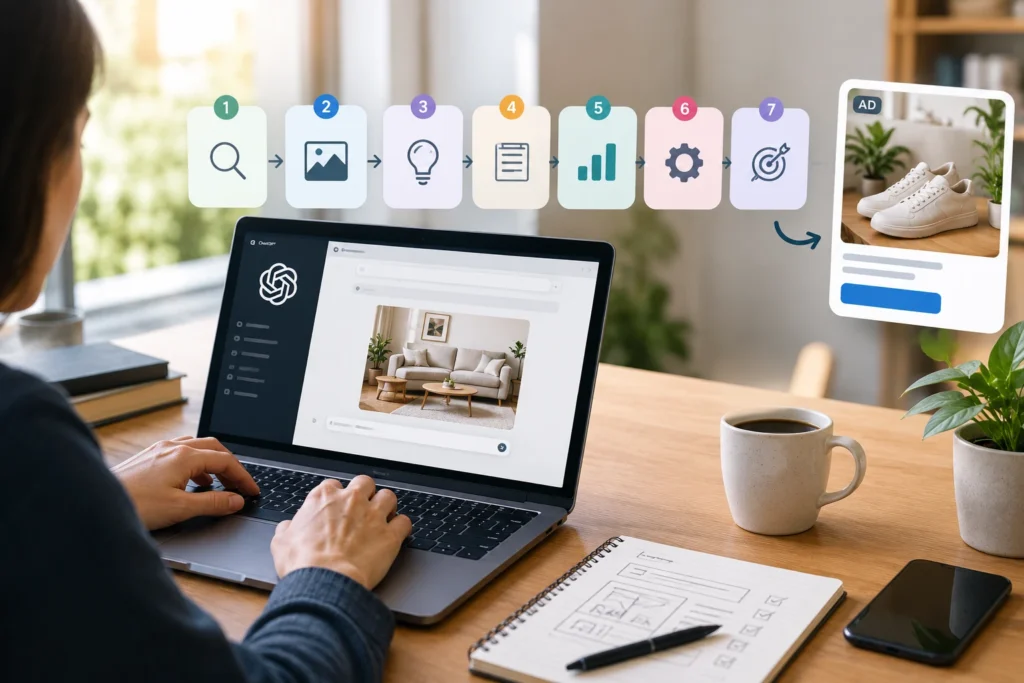
On the 5th of October, 2026, OpenAI introduced a new visual ad format for ChatGPT in an attempt to stretch the reach of ChatGPT Ads beyond the textual advertising placements system. The format is aimed at allowing individuals to search for products and services they are looking for utilizing visuals in the image generation process of ChatGPT application. Testing is expected to commence later in October 2026 with a small group of American advertisers participating in the first test run and it has been decided that the ads will be shown to users from the Free and Go accounts.
There could be opportunities for e-commerce brands, consumer brands, marketers, and advertisers, who are eager to connect with customers while they are exploring new concepts and goods with the help of artificial intelligence.
There is a significant gap between what OpenAI has announced and what remains unknown. Although the firm has outlined the objectives of the approach and its preliminary testing plans, it has not disclosed all pertinent specifics which a business would require in order to implement a complete campaign.
We will discuss what ChatGPT Visual Ads entail, the mechanisms behind them, which companies could potentially gain from them, how companies could prepare for this new opportunity, and what marketers should consider prior to using this innovative advertising channel.
Table of Contents
What Are ChatGPT Visual Ads?
ChatGPT Visual Ads is a new advertising format introduced to assist companies in displaying their products, services, and experiences using images in the image-generation experience offered by ChatGPT.
The aim of this format is to allow the appeal of a product to be expressed through visual representation rather than merely written form. OpenAI provides examples such as using the visuals to inspire creation of products, showing how the product is used, and helping people imagine experiences offered through the product or service.
For example: Imagine someone exploring ideas for a home office, planning an outdoor trip or looking for inspiration for a living room. Visual advertising could give a relevant brand another way to introduce its offering during that discovery process.
These are illustrations, not confirmed examples of live campaigns.
According to OpenAI’s announcement, the testing will be starting in October 2026 in the United States with some advertisers. The details regarding the advertisements indicate that they will be labeled properly and separated from the images being generated. Advertising is not supposed to affect the results obtained via ChatGPT.
How Do ChatGPT Visual Ads Work?
OpenAI’s announcement establishes the general purpose of the format, but it does not include all the details about the campaign. The possible experience may include:
- Image generation: A user creates or explores images in ChatGPT
- Relevant advertising: A visual ad may appear in connection with that experience
- Product discovery: The ad helps the user explore a product, service or brand
- Further action: Depending upon the available ad features a user may be able to visit the advertiser’s website
Ad placement, campaign controls, targeting options and engagement features should be verified in OpenAI’s Ads Help Center as the format develops.
OpenAI mentions in addition that ads don’t affect the responses produced by ChatGPT.
Which Businesses Could Benefit?
Visual advertising is often useful for companies that sell products and services that are easily understood through the use of images.
- Retail and e-commerce: Furniture, clothing, cosmetics, electronics, and many lifestyle brands
- Home improvement: Lighting, furniture, decorations, and other things
- Travel and hospitality: Hotels, travel companies, travel destinations, and providers of services
- Consumer brands: Businesses that are able to show their products visually
- Marketing agencies: Agencies that provide their clients with creative materials and help them evaluate their marketing campaigns
These are only possible cases rather than certain categories that can be used to get a guaranteed result.
How Businesses Can Prepare
OpenAI has stated that Visual Ads will first be tested with an initial group of U.S. advertisers, so most businesses can’t use them yet. The brands that benefit most from a new format are usually the ones that already have their creative, landing pages, and measurement set up when access opens.
Here is how to prepare without assuming you already have access to Visual Ads:
Organize high-quality product images
Visual ads utilize imagery which means that the quality of your images is even more essential than if text ads are in use. Begin the process with collecting images that are easy to understand in a clean background as well as in a lifestyle context. Use images that demonstrate the product’s real features and avoid staged scenes that overpromise.
Keep the original high-resolution pictures organized and labeled for easier cropping or resizing later. In addition, check if you have the rights to each of the images.
Keep the message simple
Rather than including every single feature, promotion, and discount in one image, it is more efficient to identify one important message to communicate to the viewers. An example of such a particular message could be comfort, ease of use, or durability. It is worth emphasizing the chosen point in the visual as well. Avoid cluttering the image with unnecessary details or unsupported claims, since exaggerated advertising can damage trust.
Improve landing pages
A compelling image will not take you far unless it is backed up by good content on the landing page. A proper product landing page must contain all necessary info like detailed description, up-to-date price, availability, and shipping information along with clear calls to action like “Add to cart” or “Book a demo”.
The landing page needs to reflect the content of the advertisement. When a specific product is advertised, landing page visitors should be directed to the specific product instead of a general category. Additionally, ensure that the landing page loads fast and works well for mobile users because many ChatGPT users will be looking for answers using their phones.
Prepare creative variations
Instead of using the same image all the time, come up with different approaches for concepts including the product design, practical function of the product, and customer needs.
For example, one could be related to how the product looks, another to how the product resolves an everyday issue, and the third could be about who specifically the product is targeted at.
This type of variation could prove useful in case the campaign tool allows for creative testing, as you will be able to learn about what works rather than to rely on pure guessing.
Set measurable goals
Determine how you will measure effectiveness in advance of the expenditures. Your objectives may include, but are not limited to, qualified leads, sales, conversions, customer acquisition cost, and return on ad spend.
Make sure to set up tracking methods in advance, including UTM codes and results tracking, in order to benchmark against your other channels. Keep in mind that visual elements may appeal to visitors who do not click immediately, so clicks alone should not be the only measure of assessment.
Keep track of the official updates
Information about availability, eligibility criteria, and program requirements can change rapidly with the continuation of the OpenAI testing process. Therefore, you need to check the OpenAI Ads website along with the Help Center page of the Ads program to get the latest updates, avoiding relying on third-party sources. You should treat everything that has not been confirmed by OpenAI as unverified information.
How Much Will ChatGPT Visual Ads Cost?
OpenAI has not revealed the pricing information related to the new visual format.
Businesses should avoid relying on claims about cost per click (CPC), cost per thousand impressions (CPM), minimum spend, or expected ROI unless they come from OpenAI.
The current ChatGPT Ads Manager offers several campaign objectives and billing methods, but businesses should confirm whether and how they apply to Visual Ads before estimating costs.
Before investing money, make sure to clarify the following:
- Whether your business is eligible
- Which buying and bidding options are available
- Whether a minimum budget applies
- What creative production may cost
- Which reporting and conversion-tracking features are supported
Start with the budget you can afford to test and increase spending only when performance data supports it.
How Will Businesses Measure Performance?
OpenAI’s announcement in October also outlined ways of expanding measurement features and partnership for ChatGPT Ads. Partners include Hightouch, Tealium, and LiveRamp for sending conversion data, as well as attribution providers including AppsFlyer, Triple Whale, Adjust, DV Rockerbox, Northbeam, Branch, Singular, and Kochava.
However, this news should not be perceived as indicating that all integrations are offered for Visual Ads. Advertisers should verify the features available in their campaigns.
Potential metrics include:
| Metrics | What it measures |
| Impressions | How often an ad is displayed, where reported |
| Click-through rate (CTR) | The proportion of impressions that result in clicks |
| Cost per click (CPC) | Cost per valid click, where applicable |
| Conversion rate | The proportion of visits that complete a desired action |
| Cost per acquisition (CPA) | Cost to acquire a customer or lead |
| Return on ad spend (ROAS) | Attributed revenue relative to advertising spend |
| Incremental impact | Whether advertising generated additional results |
There is no guarantee that all metrics would be available for the new format. Also, attributed sales don’t prove the ad caused those sales, which is why incrementality testing matters.
Will Visual Ads Affect Organic ChatGPT Recommendations?
No, OpenAI says advertising doesn’t influence ChatGPT’s answers. Buying an ad shouldn’t be treated as a way to purchase an organic recommendation or citation.
Businesses should manage paid ads and organic discovery as separate strategies. Useful content, accurate product information, credible sources and a technically accessible website can support online discoverability but none guarantees that ChatGPT will mention a business.
ChatGPT Visual Ads vs. Google Ads and Meta Ads
Google Ads and Meta Ads are well-known advertising platforms. ChatGPT Visual Ads are a new advertising form that connects with image generation.
| Platform | Main advertising environment |
| ChatGPT Visual Ads | A visual format associated with image generation in ChatGPT |
| Google Ads | Google search and other supported placements |
| Meta Ads | Facebook, Instagram and other Meta placements |
What channel is best relies on a number of things, including the audience, business objectives, budget, available features, and result measurements. Unfortunately, there is not sufficient public knowledge to say that ChatGPT Visual Ads are better than either Google Ads or Meta Ads.
To see how conversational ads differ from search ads in matching, bidding, and measurement, read our comparison of ChatGPT Ads vs Google Ads.
Common Mistakes to Avoid
- Assuming every U.S. business can access the initial test
- Treating unconfirmed pricing, targeting or campaign features as facts
- Using misleading or inaccurate product imagery
- Sending visitors to irrelevant landing pages
- Expecting guaranteed sale or positive returns
- Confusing paid placements with organic ChatGPT recommendations
- Increasing spending without measuring business outcomes
Are ChatGPT Visual Ads Worth Watching in 2026?
Yes. The format is worth tracking, particularly for e-commerce businesses, consumer brands, and companies that rely on product visuals. However, OpenAI hasn’t shared details about pricing, performance, or wider availability.
In the meantime, consider ChatGPT Visual Ads as a new prospect rather than a proven alternative to current advertising options.
Fleviko’s Take
ChatGPT Visual Ads give businesses a new way to introduce products and experiences through imagery. However, adopting a new ad format doesn’t necessarily guarantee profitability.
Our recommendation is simple: Create the right visuals, optimize landing pages, formulate measurable objectives and track the news from OpenAI. If your business qualifies, do trials first and expand your campaign only if there are favorable results.
The goal isn’t to follow every new ad trend. It’s to identify which development can deliver measurable business value.
Frequently Asked Questions
1. What are ChatGPT Visual Ads?
OpenAI has introduced a new advertising format, connected to its image generation technology in ChatGPT, which enables users to visualize products and services.
2. When will ChatGPT Visual Ads be available?
OpenAI has said testing will begin later in October 2026 with an initial group of U.S. advertisers. Wider availability hasn’t been announced.
3. How much do ChatGPT Visual Ads cost?
OpenAI is yet to issue a public announcement regarding pricing details for the visual format. Advertisers need to check the offerings and costs involved in a campaign ahead of time.
4. Which businesses could benefit from Visual Ads?
Visual advertising might be used by ecommerce sellers, consumer product providers, home improvement companies, along with travel and hospitality firms, although there are no guarantees in terms of eligibility and success.
5. Will ChatGPT Visual Ads influence AI-generated answers?
According to OpenAI, advertisements don’t play a role when it comes to answering questions in ChatGPT. Paid ads shouldn’t be seen as a means to obtain genuine recommendations.